Indonesia is a country in Southeast Asia. Indonesia is the world's largest archipelagic nation consisting of13,487 islands. From Sabang to Merauke, Indonesia consists of many tribes,languages, cultures and different religions. An example is the island of Borneo. Borneo has many cultures, Such as dances, customs, religious rituals are tightly attached to culture. Borneo has many beautiful dance and need to preserve. Dance of Borneo has a unique beauty and history and need for us to know.
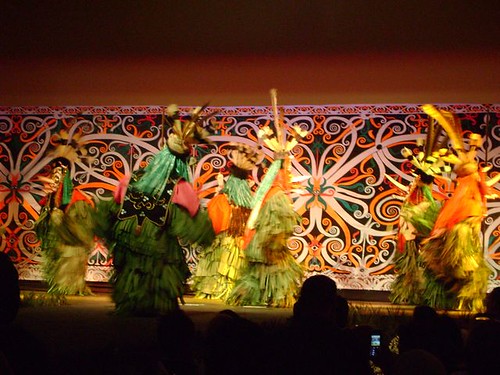
Borneohas a lot ofartof dance, onedancegongofEast Kalimantan.Gongdance,just asthe name suggests,is a dance thatis playedusing amusicalgong.The danceitselfdescribes thetenderness of agirl,whowrithedlikearice.This dance isperformed bya girldressed intraditionalDayakKenyah.Bodyandhandmovementsare slowandgentle,andthe dominance ofbird feathersinher clothingstyleis the hallmarkthat we can seeinthis dance.
Giring-giring danceis a dancebellsthatinhabit thetypicalMa'anyanBaritoDistrictEastand DistrictSouthBaritoCentralKalimantanprovince.
The dancewas popularizedby theDayaktribeMa'anyananddancedinhappyevents,welcomingguestsas wellas a distractionatparties orspecial events.In addition,danceSleighbellsarealsousedforsocial dancesinthe youthers .it was showedtowelcome guests,funevents,andalsofor kicksonspecial occasions.This danceis also calledgangereng.
Dancethe bellsare equippedwithbamboosticksandthin (telang) filledwithbeans"piding"so as to producea rhythmicsoundwith the soundwhichkangkanung(gamelan)bythe dancers.
it is dancing witha singlestompdancefloorheldthe stickin his left handand right handholding thebamboowhilerocking the babytogetthe sound,while thelegsback and forthto the rhythm ofthe song.Harmonyofhand andfootmovementsthatlead tobeautyandan attractiontowatch it.This dance isusuallytherewheneventsarefun,like aharvest festival,orcelebration, orstaring/tiwah,which is usuallytheyoung and oldcometo have funplaying softlyinkenunganddrumsounds.
Borneohas alot ofart.Indonesiaisan agrarian countrywhere the populationisworking as afarmer.many dancesthat symbolizethe life ofthepeasant like gantar dance.Gantardanceis a dancedepicting themovement ofpeopleto plant rice.Stickdepictpounderwoodwhilebambooand grainsinsidedepictrice seedand its container.
This dance isquitepopularandare often servedin awelcoming guestsand events etc.this danceisnotonly knownby the Dayak tribeTunjungbutalsoknownby theDayaktribeBenuaq.This dancecan be dividedinto threeversions ofthedanceGantarRayatn,GantarBusaiandGantartight/GantarKusak.
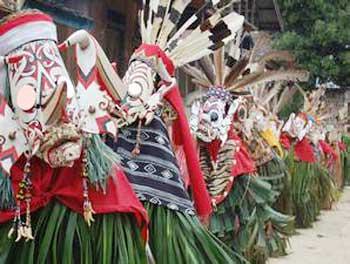
Kalimantan has many beautiful and interesting culture, Hudoq dance is one of the very interesting for foreign tourists. Hudoq is part of the ritual dance of Dayak Dayak Bahau and modang, are wont to do every completed manugal or grow rice, in September-October. All his movements, supposedly trusted down from heaven. Based on trust and Bahau Dayak Dayak tribe modang, Hudoq Dance was held to commemorate the services of their ancestors who were in the nature of nirvana. They believe in the current planting season arrives ancestral spirits will always be around to guide and supervise their offspring. Their ancestors came from noble Asung or Great Mother which descended from the sky in the upstream region Apo Kayan Mahakam River. Asung noble has the ability level of a god who can summon the spirit of good and evil spirits. By Asung superb, the spirits are called Tok Hudoq Jeliwan was commissioned to meet people. But because his form is horrible they were ordered to wear a half-bird nick. The Hudoq it came with good news. Their dialogue with humans while providing a variety of seeds and medicinal plants according to the message given by Asung superb. From that story, the name attached Hudoq and modang Bahau Dayak community. This dance is performed is closely connected with religious ceremonies, in order to gain the strength to overcome destructive pests of plants and expects to be given fertility yields a lot. Hudoq dancers are usually numbered 13 people representing 13 Hunyang peace of the patron god of gods, the god who maintains rice plants. On the sidelines of lush shrubs and trees they started wearing costumes made of banana leaves to cover the ankles and wooden mask that resembles a wild animal. Banana leaf is the epitome of coolness and well-being. Meanwhile, the color of the mask Hudoq, usually dominated by red and yellow, which is believed to be the favorite color of the gods. Mask the red color is a manifestation of god picture Hunyang quiet. Before the dance Hudoq started, first held Napoq ritual. Napoq is a sacred procession that must be performed each time to organize Hudoq. This ritual is led by a paddle that is the person who has the supernatural ability to communicate directly with the Hudoq. Accompanied by two assistants, paddle around the village as he rang the gong mebang or small. Which serves as a communication tool to accost the village guardian spirits, that Napoq being conducted. Furthermore, the paddle will call and ask the ruler of the universe which has four greetings Tasao namely, God the Creator; Tanyie ', the Lord Keeper; Tawe'a, Guidance and Tagean God, God the Mighty; so as the Hudoq can run safely and smoothly. Then, the Hudoq luncheon hosted by the oars, by way of feeding the dancers who have been possessed by the incarnation of the god who wears a mask Hudoq. After lunch, paddle also communicated with the Hudoq, called the landmark Hudoq. This communication, the Dayak language polite and refined, which can only be translated by the paddle. Of this communication, the results are usually known to the continuation of farming, whether the harvest is successful or not. Rowing was asked, that the Hudoq protect their crops from pests. Then, the ritual continued with the activities of rice ugaaitan or interesting lives. In this ritual, the Hudoq lined up parallel, the order is tailored to the social class of the gods. The gods in the highest social class were at the forefront. As I read the incantation, the exciting life of rice Hudog seven times. Hudoq dance is usually held in the middle of the field or fields to be planted. The rhythm is quite high, the dancers Hudoq Nyidok motion or the motion Nyebit forward, stomping feet. Followed by movement or Nyigung Ngedok is stomping his foot to the heel ¬ accompanied by hand movements like wagging movement of the wings of a bird in flight. This movement means to repel pests and diseases that do not attack the rice plant. In general, this implies dance moves around to the left to get rid of bad luck and turn to the right to take the good.
"Punan" means to seize, "letto" mean girl / woman. This dancetells about two young men both like a girl and fighting over it. The young man who maintains his girl bravely eventually won thebattle. It is the nature of the Dayak Kenyah, to maintain the shapeof his whatever it was.
Mandau dance is one of the various types of dance central Kalimantan Dayak tribes. looking of this dance names is certainly using one weapon that is typical of Dayak Talawang and Mandau. mandau is a weapon is a machete and talawang is a shield. . According to the Dayak tribe itself, Dance Mandau symbolic of the Dayak community spirit in defending the dignity and status. It also symbolizes virility Dance Mandau Dayak tribes in dealing with all sorts of challenges in the aspects of life.In addition to this dance tiu also a portrait of how the Dayak tribe defend his homeland or territory . In every show or dance offerings Mandau lacks with rhythm sonority Gandang and Garantung. Harmonization of these traditional music devices led to the rhythm of passion, as if to invite those who heard and witnessed the offering of Dance Mandau increasingly excited as the Dayak warriors who are ready to jump into the battlefield